

Phil Howard & Roy Cherian
405- From Submarine Periscopes to the C-Suite w/Roy Cherian
405- From Submarine Periscopes to the C-Suite w/Roy Cherian
Roy Cherian
ON THIS EPISODE
Roy Cherian is Director of IT at True Manufacturing, a 1,140-person commercial refrigeration company founded in 1945. He's been through the dot-com era, smartphone revolution, and now the AI inflection point across five industries.
The problem? Ninety-five percent of enterprise AI deployments fail to generate ROI. Roy's tired of the fluff. "Don't be a puppet. Don't sprinkle some AI on it and say it'll solve the world's issues."
We get into why organizations skip AI literacy, pick tools before use cases, and treat every problem like a nail because all they have is an AI hammer. Roy breaks down his BlackBerry-to-iPhone analogy for agentic AI, why you need your CISO facilitating (not reviewing), and how to stop pretzeling yourself to executives who still see IT as a support function.
The five percent who succeed are extracting millions. Roy doesn't want to be in the ninety-five percent.
Episode Show Notes
Navigate through key moments in this episode with timestamped highlights, from initial introductions to deep dives into real-world use cases and implementation strategies.
[[00:00:00]] Introduction — Roy's Navy background, submarine periscopes
[[00:02:30]] Engineer Arrogance — Why Roy didn't respect IT people initially
[[00:05:15]] Jimmy Buffett Teacher — Community college RPG class that changed everything
[[00:08:45]] Coding as Artistry — From Commodore 64 to AS400 green bar printers
[[00:12:20]] Dot-Com Parallels — AI hype versus internet adoption patterns
[[00:16:10]] BlackBerry to iPhone — Roy's analogy for agentic AI adoption
[[00:19:45]] 95% Failure Rate — MIT data on AI deployment ROI
[[00:23:30]] AI Literacy Crisis — Agentic versus AGI, business user confusion
[[00:27:15]] Point Solutions Strategy — Stop building the ERP of AI
[[00:31:00]] Use Case First — Find the problem, then find the tool
[[00:34:20]] Manufacturing Focus — Defect tracking, cost of goods sold reduction
[[00:38:45]] AI Steering Committee — CISO as facilitator, not reviewer
[[00:42:10]] Security Governance — Salary data nightmare scenario
[[00:45:30]] Executive Communication — Analogies, not technobabble
[[00:49:15]] Budget Pretzeling — Stop explaining, start partnering
[[00:52:40]] Gartner as Librarians — Research tool, not buying guide
[[00:56:20]] Stop the Fluff — Roy's challenge to AI hype machine
[[00:59:45]] IT Evolution — Support function to strategic advantage
[[01:02:30]] Closing — iPhone versus BlackBerry for IT leadership
KEY TAKEAWAYS
TRANSCRIPT
Phil Howard: So talk to me, man. How do you get started in this whole IT thing? What was your first computer? Where did you start out as an engineer or a creative writer or something? No one starts out in IT at our age.
Roy Cherian: Yeah, yeah. Nobody does. Started out Commodore 64. So I was in the Navy, and I worked on optical electrical systems for submarine periscopes and stuff. So I went the engineering route. And honestly, when I was an engineer, I didn't really respect the IT guys because all of the problems are all logical, right? When you're working with something like submarine periscopes, you got temp, vibration, seawater pressure, all these other factors that come into the systems, etc. But then I was going through graduate school and I took a...
Phil Howard: Hit on this subject, first of all, because this is actually an interesting subject, because one of the problems that IT guys have a lot of times in organizations, especially if they work in an organization with a lot of R&D and a lot of engineers. So they have a lot of smart people, the smartest people in the room. And what do the engineers not want to do? Follow security protocol and not be able to...
Roy Cherian: Oh, yeah.
Phil Howard: They're terrible. Exactly. So you were that person? So why did you have no respect for them since you were there? And now you do? What can we do to fix that?
Roy Cherian: I was young, alright. I was very young at the time and I really didn't get into it until I took a community college class just to sharpen my IT stuff. I took COBOL, it was a micro focus COBOL and RPG for the AS400. This is back in the mid nineties, right? And the first day in the RPG class. It was a community college class, right? A guy came into class. He looked like Jimmy Buffett been working, obviously doing some shorts.
Phil Howard: Bermuda.
Roy Cherian: Bermuda shorts type guy. And he started out the class saying, the class officially starts at six, but I'm not going to get here before seven. I'll stay as late as you guys need to get the work done. And so I was like, I'm going to like this guy. So I started...
Phil Howard: To go back in time. Set the stage. What year was it?
Roy Cherian: This was 1997 or 1996. All right.
Phil Howard: And Windows 95 nearing and XP and NT or whatever. Anyways go ahead.
Roy Cherian: Yeah. So I took the RPG class and I was like, this stuff is cool. Being an engineer RPG is very formatted, right. So I read the book, it was by a woman named Judy Yeager. That was the, for people that worked in RPG back in the day, they know who Judy Yeager is. So it was very easy to read. And I just fell in love with coding. I would read ahead, he'd go through if-then-else and I'd say, well, can I use subroutines? Which is later in the book. He says, absolutely. Do whatever optimally. So, this is where we still had green bar printers and all that. So that's how I fell in love with coding and started, I was still in the Navy at the time. So when I left the Navy, I went to a company that had AS400 Lawson financials, all the AS400 related software products.
Phil Howard: Still useful.
Roy Cherian: Yeah. So that was down in Birmingham, Alabama, and then moved all over the place, worked in multiple industries, went from a retailer to construction, concrete products to defense contractor, and then continued from there. But the great thing about IT in my viewpoint is, if you have a passion for completing that puzzle or we're puzzle oriented people, right? Fixing it.
Phil Howard: Here's how IT people say it. After almost four hundred shows, curiosity should be one of the number one ways of being in IT. If you're not curious, then you might as well get out.
Roy Cherian: Yeah, if you're not curious, then you're just sucking up air. Here's the thing. During the dot com era, we had a lot of folks taking those classes, just trying to get into the business. And I could see, they're very linear in their thought. They didn't really... my instructor, the Jimmy Buffett guy said, Roy, you should really get into this. He knew I was taking it on the side going through grad school, right? So, MBA is what I was going after. So I said, well, there's no money in this. This is too easy, right? Because it's not hard, like, some engineering. Yeah, there's a lot of money in it. And that's how I got into it. And I really enjoy doing it. And at the defense contractor, when I first interviewed there, my manager asked me, well, what do you want to do five years from now? I said, I'd want to do the same thing I'm doing now, which is coding. So but from there, I realized even in...
Phil Howard: A really good subtopic here that we're skipping. What's that was a really good sub topic that I want to skip over because you mentioned comm phase. We still haven't answered how Jimmy Buffett, Bermuda shorts wearing guy somehow led you to respect IT people and not be an arrogant, engineer minded guy. Somehow there's some connection there that we're...
Roy Cherian: It's an artistry. I forgot we got in the puzzle conversation, right? But it was, you can make artistry in code and make it very tight, right? And very cool when you make your first. And it kind of reminded me back to the Commodore 64 fooling around in my room, being able to code and do something right. So that's what I like watching.
Phil Howard: Coding.
Roy Cherian: Yeah. Yeah. Baywatch. It's like, Hasselhoff guy, it's like, I'd love to be that tall David Hasselhoff.
Phil Howard: Yeah, yeah. And again, it's a very interesting correlation because most people wouldn't. The other thing that you really wouldn't kind of go side by side with engineers also is maybe artistry and art, but there is kind of a mix of people, but it's like this artistry. You get perfection at the same time. And the reason why I'm saying this is a really good side topic here is, well, first of all, you're mentioning the dot com era, and he said that you should really get into this, which I would love to know what getting into it meant. And how does that correlate with the new era of...
Roy Cherian: Getting into IT as a profession.
Phil Howard: Yeah. Okay. Okay. Great. So now what about AI because we have some similarities and some very big differences because back then the dot com era was like, I don't know if it's really ever going to take off. Sears had the wrong approach. Obviously Toys R Us had the wrong approach. They're all sunk now and dead. And obviously Mr. Bezos did not have the wrong approach. And so people were kind of screwing around and late to the game and now it's almost the opposite. It's like everyone has to get into AI. We have to get into AI right now. And it's kind of a there's some similarities, but differences. I'm just curious as to what if you have predictions. What's your prediction here of what's happening right now?
Roy Cherian: Well, it's funny you mentioned that. That dot com similarity here. My prediction and I said this, I put this on a LinkedIn post actually, I loved my BlackBerry and when I went to the iPhone, Samsung, I didn't really see the value of the iPhone because all I cared about my BlackBerry was my email and phone. Right.
Phil Howard: And physical keyboard.
Roy Cherian: Yeah. Physical keyboard. Right. And it wasn't until later. And I was like, I have all these apps, I'm going to have this app for Waze that I can navigate the optimal path and know where law enforcement is in case I have an emergency while I'm driving. Right? So now I'm looking at some of this agentic AI solutions as stop looking at it like you have to build the ERP of AI. Maybe point solutions that bring immediate value or near-term value can help a business out. And just like those apps, right? I wouldn't go to the Waze app for weather necessarily. But I know it does a good job in what it does. So maybe the agentic solutions, while you still have an overall path to get to kind of the ERP of AI, you kind of build these little nuggets all along the way and then success breeds more success. The CEO is wanting to do something in AI, but so does every other CEO in the country. You build those use cases out and you put them into fruition. I mentioned also like, five percent of AI use cases right now are successful. And bring ROI. That's a bad success rate when ninety five percent are failures. And I'm wondering what...
Phil Howard: But the ones that are successful...
Roy Cherian: Are extremely successful. Yeah.
Phil Howard: Yeah, I was just talking about this with the team this morning, and I have the statistics here well, I mean, yeah, you're absolutely right. It's the opposite. It's ninety five percent of deployments fail to generate ROI. Yeah. And obviously. Yeah. Enterprise. Yeah. Okay. Yeah. In five percent are extracting millions of dollars of value in kind of this. It's perfect for the mid-market space because I think mid-market guys have in mid-market to fortune five hundred. Some people get offended when you say mid-market. Fortune five thousand. Emerging fortune five thousand.
Roy Cherian: Yeah. Emerging. Okay.
Phil Howard: What else was in that? Like forty three percent of data leaders point to data quality, completeness, and readiness as the biggest obstacles for Gen AI. Forty five percent believe that concerns over the responsible use of AI prevent them from demonstrating business value. Okay, so we've got security in there. Ninety one percent of mid-market forty five thousand firms have adopted Gen in twenty five percent of companies using Gen AI say it's fully integrated across their core operations or workflows, while forty two percent say it's integrated across some operations. So we know there's a lot of people that just say, oh yeah, we're in. We're fully deployed AI and you've got CTOs are like, we are like, so but that's like beside the point. How does this compare to the dot com era and why is everyone... Is everyone ready for it now? Because back then they weren't ready for technology because we didn't even have the internet yet.
Roy Cherian: I think one, a lot of folks are scared of AI. We had the general user community, right? They're afraid of not having a job type of stuff. We had a big poll when we had a whole bunch of folks in. What, are you excited about AI? Yes. Are you scared about AI? Almost everybody had their hands up. Maybe five people didn't out of a group of fifty. So it's unlike the dot com era. There is the "Am I going to still have a job?" concern. And then AI literacy is the big thing I hit on. I told in our senior managers meeting, I'm not... you have agentic AI, and then you have artificial general intelligence. And I kind of said, hey, AGI, nation states are battling for supremacy there. I'm not worried about Terminator from a business sense. Or Skynet.
Phil Howard: Personally, I am no.
Roy Cherian: Well, yeah, that's a different topic, right?
Phil Howard: Topic.
Roy Cherian: I got you. So what we can control and be able to use is agentic AI solutions. And that's where my focus is. And being able to take advantage of the capabilities in there and find the right solution there. I had a scenario at my old company where we were trying to find a contract, any type of email traffic on a contract, would bring significant revenue, legal related activity. Right. And we were looking at the usual email e-discovery and the Microsoft said, here's the benefit of like a Copilot. It's a vector related search compared to the standard e-discovery search that we do. And you may be able to get the end result you're looking for because you're attacking it at two different angles. And it makes perfect sense to me. Unfortunately, we didn't find it. There was no historical document seven, eight, nine years ago that could have made a difference. But the point is, I was like, okay, we're looking at it differently. It's not just the same Google search that we had before. And when I said AI literacy, people, agentic versus artificial general intelligence, business users don't know the difference, right? And then even with agentic and understanding, you still have to train the models. You have to start with not really build your own. Maybe get a COTS, commercial off the shelf product that then you tune it to what you need. I'm not going to have a model that, or an AI, say, chatbot or something, that person's going to come to it because I sell coolers and ask me what the capital of Argentina is. Right? So they're going to be very business centric. So, train it correctly and spend that time.
Phil Howard: So everything you said is right on point from that piece. Yeah. I'd be interested to see what kind of point solutions you guys are interested in. So that MIT article had like three main... It basically had three main reasons why people struggle with it. It was number one was misaligned strategy. And people don't even have an AI strategy to begin with. Right. And then poor adoption of anything that they actually do implement because most of the so-called in quotes, sanctioned tools, fail to meet the employee needs support adoption. And so you have people doing shadow. Now you've got the fear of shadow AI and security issues. And then to your point, though, implementing this point solutions and everything leaves fragmented platforms and complexes.
Roy Cherian: There's a potential for that.
Phil Howard: But I disagree with a lot of what they're saying though, by the way.
Roy Cherian: Okay.
Phil Howard: So I only disagree because I can understand the building thing versus like, don't build like buy versus build. I think that might be one of those like kind of Gartner pay to play things where they're like, no, because we want to buy stuff from people. But I'm telling you, we've built some... I mean, if you have a really good AI team and you have a DevOps team, that's ready for this onslaught of change. And they're like on top. They're like ahead of the curve. I think those point solutions can be... you can start like knocking those out of the park, one after the other, and you don't have to...
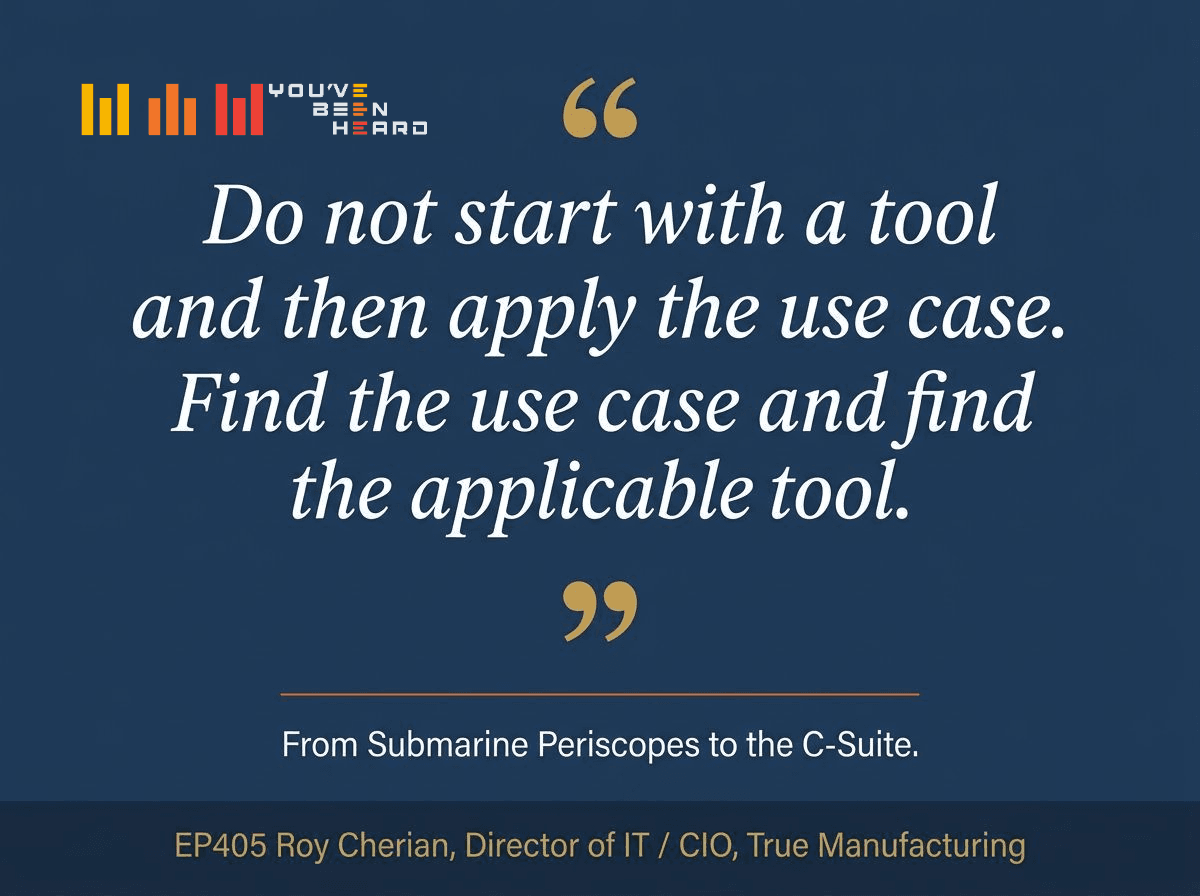
Roy Cherian: Yeah, one hundred percent agreement. The key thing is AI literacy across the board IT and operations and back office. Because what ends up happening is they pick a tool and it's like if all you have is a hammer, everything's a nail, right? So they're not necessarily looking at it as use cases and seeing if I had this, if I could lower my defect rate from one part failure per one thousand to one in one hundred thousand, it's one hundred fold increase, right? Because, the rework costs, etc. So it's changing the paradigm shift or having a paradigm shift to get to look at it almost as process improvement elements. And forcing people not to think this is one big magic box here, that magic just suddenly happens without the diligence and putting some elbow sweat into it. To get to the end result before you start taking, don't start with a tool and then apply the use case, find the use case and find the applicable tool.
Phil Howard: Yes. And that's what's difficult if you don't have someone at the helm creating a strategy in a way that people understand how all this stuff really, really works. And I think there's going to be a lot of fail forward type of stuff.
Roy Cherian: And it's not always bad to fail, because hopefully you learn from your failure to move on to the next right. But it's better to fail with small things and then be able to get that success. And you learn, just like they use the crawl, walk, run, right? You when you're crawling, the baby stubs his toe, falls on his face a couple of times. But it's better than falling when you're standing up or running.
Phil Howard: Yes. So much has happened in like two months. Like three months ago, I went from saying that the AI coding is like really sloppy to, well, it's sloppy, but it works great now and then. As of this week, I saw actual almost like a knowledge worker happen with the Claude Opus like release and the kind of work I think, which actually scares the crap out of me. And it should scare the crap out of a lot of security people because it's just like, yeah, have access to my drive. Yeah. Go ahead, search. Go to my browser. Yeah. Do this, do that. I can see that being very problematic with a lot of companies right now, but I think a lot of people probably don't even know what it can do.
Roy Cherian: Yeah. There are going to be changes that are more rapid. Right. If I go back, I was unemployed for about six months, in the job search between my last and this. Right. So I spent a lot of time actually read Google's article, "Attention Is All You Need." Did a lot of because I really wanted to understand. I didn't want to get into the math of the algorithms behind the scenes, but I just wanted to understand what it does. Right.
Phil Howard: So what was the summary of that? Attention is all it needs.
Roy Cherian: Well, it's almost like to me, if I was going to summarize it, it's almost like parallel processing. Instead of looking at it as linear. Think of the searches. The vector searches being parallel and then building within the LM space. Building a full paragraph. Because now, I look at it back in like Teradata Days when... Oh, they have multiple stacks going, multiple disks going to, not single threading, multithreading jobs. Right. So that's how the crux of it for me, that's what I learned from it is. Oh, okay. That's pretty simplistic when you think about it. A couple of Google engineers said, why don't we do it this way? Multithreaded. So use that same philosophy there. And as far as AGI, my only two bits on that until really get to quantum computing, I'm not afraid of Terminator. So maybe a couple years down the line. It's not that long, right? But we were talking about that.
Phil Howard: Yeah. So you're reading that time off six months? Read the Google thing and, Yeah.
Roy Cherian: Yeah. And did the Harvard course, the free Harvard course, etc., try to soak right into AI and then, my present organization, we make world class refrigeration units. We were looking at AI simply from an RPA engine, that is AI because that's all they see. Is that the hammer? That's the hammer. And everything's a nail, right? Instead of getting AI literacy down to the masses, to the decision makers, etcetera, and then finding the valid use cases, having an AI steering committee or AI working group doing the foundational stuff right? To get people knowledgeable. And then, let's not make the mistakes of the past. Let's not be part of that ninety five percent. Let's nail down the use cases. Let's find tools and let's get a partner. Why do we have to do the journey by ourself? So we're looking at a partner that will help us on our journey. And twenty percent of their client base is manufacturers. And when I looked at Gartner to see, well, what's the use cases that manufacturers do, right. Gartner, I consider librarians to help me get the knowledge I need to pursue. And they said defect tracking for manufacturing space. Basically all the stuff that reduces cost of goods sold. Right?
Phil Howard: Process.
Roy Cherian: Yeah. Process engineering.
Phil Howard: Yeah, yeah. Because, I mean, in manufacturing, there's a lot of things that we just do from a kind of, to your point, like a linear start stop type of thing that could be organized better for better output, batching and things like that. I mean, we've had plenty of people on the show that were able to increase like efficiency by like one hundred and seventy percent and get rid of temp staff, all because they were there batching orders wrong and placing a broom in the wrong end of the warehouse and having to clean machines just to make a new thing and stuff like that. Whereas if they had batched orders correctly and it was just like,
Roy Cherian: In manufacturing, I see a lot of similarity between like a Six Sigma process improvement approach with layering AI on top of it. It's almost like it's...
Phil Howard: Do you think it would be useful if we all put our heads together and had a almost like, four hours to get the outline of your AI strategy together in like seven steps or something like that. I'm just trying to think of like, is there? I don't know if there is anyone that's done that yet, like how to put together your AI steering committee and your AI strategy. Would that be helpful?
Roy Cherian: I think it's helpful for any organization that's starting. Yeah, absolutely.
Phil Howard: Or even how to train your end users. Everything about AI the right way the first time without, you know what I mean? Something like that, because I think, our producer, Greg, he's, been I mean, he we've been on this kind of, like, AI thing from the very, very beginning and made all kinds of mistakes. And I think that that's what I realized is if your end users don't learn it now, It's going to get to the point where if you start using it, you're going to be behind because you have to build this entire almost library of skills and resources and train models to work for you versus you. Kind of, like you said, just hammering nail, like I'm only using it this way. Whereas if you really kind of understand, how things work, you won't. I just realized I'm, like, way behind on a lot of kind of, for a while I was like, okay, which LLM how do we use this? What do we use for this? What do we use for that? I just kind of like this. Like insane asylum of, like, each week. Oh, well, this is better than that. This is better than that. And finally, you get to the point where you're like, no, I've got to pick one thing. Or if I don't pick one thing, I have to have my own personal strategy for information that I feed these models in a certain way, and it's got my data has. It's the same thing that everyone talks about. It's got to have my data organized in a way that's going to be efficient for these models.
Roy Cherian: You're mentioning stuff I put my LinkedIn on there with, coming in ninth place on AI, right. I call it the participation trophy, right? So my, how is relating it to AI is, you can define what first place is. Whatever. Right. Because there is no first place if we're racing against ourselves. But if we nail down those incremental wins and we get those big wins, then ball game, right? So, and it just improves from there. Let's stop trying to find the perfect answer is, I think the crux of what you were just saying, take a path and stick with it and then, mature as you go on. But by overanalyzing, starting the process, at least getting steering committee, at least getting AI literacy nailed down to the masses, education kind of first. But I know CEOs are always looking for, what quarter are you going to have some product ready? But emphasizing AI literacy and having that maturity curve keep on growing, I think is going to be the path to get solid results.
Phil Howard: It's a great transition Okay, so the C level executives are like okay, what do we got in production? What are we doing for AI? Are we all in for AI? Because I already told the board, yeah, we're ninety percent AI and they've got a lot more pressure than us, believe it or not. Yeah, a lot of times, CTOs and CIOs where there's this, interesting duality going on. Because a lot of times we're saying, oh, well, we have a seat at the executive round table. Okay, great. And I want to hear how you answer this. And I know you probably already answered it. I didn't I didn't like the answer, but I'd rather do it live. So after all these episodes. Right. Everyone knows nothing gets done in any company without IT anymore, whether they want to admit it or not. Great. But I still think that there's a lot of insecurity around do we trust IT with the business and making business decisions? And that's IT's fault because we need to speak ROI, EBITDA, we need to speak bottom line flow through profit, all these different things. Right. So we may have a seat at the executive Roundtable. We complain about being the department of IT or not being the whole company or not being there, kind of like right up with like, do we see our team as the C level executives or do we see our team as the help desk and all the guys that we're in charge of? So anyways, having seen the roundtable, nice, right? We started out in technology. We rose all the way here. We are in this position. But how much nicer would it be to be heard? Do you have any thoughts on that?
Roy Cherian: Well.
Phil Howard: Like I mean heard and understood like from a technology perspective, a lot of times we understand them and we may not enough and we may not speak up enough and speak in ROI and all those terms. But how nice would it be for us to be heard and understood from the technology angle?
Roy Cherian: Absolutely. First, know your audience, right? So if I'm not going to do technobabble in what I call technobabble in front of the C-suite, right to the CEO, etc., I always use analogies to explain concepts, right? I use the analogy of BlackBerry to iPhone to apps. Waze. Right. To explain how for Agentic AI, we may need to look at this. Right. So using analogies and being able to relate it to bottom line impact, etc., the C-suite, IT managers that want to move into like C-suite type roles, need to be able to convey that in and without the technobabble, right? My boss or my boss's boss, right? Would know what Vlan separation is or any of the, other stuff, technology professionals would understand, right. So,
Phil Howard: Explain EDR.
Roy Cherian: Well, it's funny you mentioned EDI because, depending on the company, I came here and I've been working in EDI type stuff for twenty years. EDI been around for forever, right? But how they see it is not how it really is. I was like, yeah, well, that's not EDI, that's how they see it. So.
Phil Howard: Yeah. How do they see it?
Roy Cherian: Yeah. So that tells me, technology maturity had challenges, So each company is unique, right. Each corporate culture is unique. Of course. So your original ask, I hope I answered is use analogies. It don't use the technobabble. Try to get it to home on the C-suite to say that I'm a partner, you and a trusted confidant, like the internal counsel, the legal officer, whoever it is, right, is out for the company's best interest, showing that you're out for the company's best interest. Why? You see this as going to lower the cost of goods sold, or why this is going to increase revenue or, reduce risk. Have that solid, business relatable item in front of the C-suite. And even if you have to take them on a journey to get to that relatable item, educate them to get to that relatable item to them. Right?
Phil Howard: Yeah, I love it. I think security is one of the harder sales because it doesn't always Necessarily point to new revenue. It points to not losing revenue.
Roy Cherian: Yeah, it's a risk mitigation. The world is a dangerous place. And I emphasize this all the time. We're looking at our Microsoft agreements. Other things to see do we have the right security posture? My partner in this AI journey to help facilitate it is our CISO. So I wanted to make sure. Hey, we're not running off. I even said it to the managers. The worst case scenario to me is someone does have an AI engine of some type, and you ask them what the company's individual salaries are for all of our managers and all the eyes went up and said, yeah, that's why we need to protect against it. And we have to have a strong security dimension to how we build these AI products. And how better to do that than have the CISO actively engaged as a facilitator in these projects that we're doing.
Phil Howard: Do you start with the the fear slide, or do you end with the fear slide when you're selling security? For example, I was just talking about this the other day, and I'm just looking at presentation that we're doing around healthcare and security, that the average healthcare breach in twenty twenty five was seven point four two million. Yeah, supposedly. If these numbers are right. Right. Yeah, it's probably higher. Which was three times higher than other industries. And it was up from two point eight seven two point seven billion. No change in healthcare attack in twenty twenty four. Sixty seven percent of healthcare orgs were hit in twenty twenty four with something that's that's really astronomical. The average downtime per attack was nineteen days.
Roy Cherian: Oh, I didn't hear that metric before, Ah.
Phil Howard: But, but this is for the ones that were, like, really hit with bad ransomware, right?
Roy Cherian: Well, that should remind Non-IT professionals how serious it is for our discipline to exist, right? And we can't just be a truly just support function, right? To keep the lights on, etc., is to be at the table, preventative measures. You try to do the best job you can to prevent scenarios. And then when a scenario happens, having a good mitigation plan, somebody had told me, IT security should look at a set of like looking at it visually as five basketball hoops that go backwards and forwards, and for the hacker to penetrate has to hit the right sweet spot that all hoops are all centered, right? So you try to make the multi-layer defense, you know that it's not a question of if, but when a scenario happens that a breach happens or an attempted breach happens. And then what's your mitigation strategy? Don't fool yourself into thinking it can't happen to me, regardless of how impenetrable you may be from the outside, you may be very impenetrable from the inside.
Phil Howard: Um, three hundred and forty percent increase in OCR enforcement. That means They're after you. Healthcare Max. Annual penalty last year. HIPAA penalty, two point one million. The largest ever Anthem. I'm assuming that's anthem Blue Cross, Blue Shield, or whatever, settlement was sixteen million. That was the security piece, but just from how IT can partner with the business if you had like, three steps, five steps or six steps for your, technology, digital transformation or to partner with the business when you come in and create that type of really great relationship with the business. What are some of the big ones for you?
Roy Cherian: Well. You asked originally, the fear or the promise, right?
Phil Howard: Yes.
Roy Cherian: And I say both. One. Even on the promise, it's not going away. It's not like the dot com era in that instance where internet was still new. We are living in an AI world, whether we want to be a part of it or not. Right. And that's not going away. So let's adapt there, but realize the fear component. And being able to mitigate risk, on this side is just maybe not just as important. I think we sometimes go too far into the fear, to get to the right end result. It's coming. And we're in our beginning stages. Right? So adapt and be willing to adapt. Don't worry about losing your job, even if you're on the security side, because the machine isn't that smart yet, right? And look at the potential for growth. Right. As a business, and how IT is essential part of that. We can't own the AI journey. We can help facilitate it in IT. Right? The operations, in my case, manufacturing, the back office. Guys, the CEO have to help because they set the strategic objectives of the company. Right? So, we're part of that journey. So, I don't know if I answered your specific question there.
Phil Howard: Okay. So I'm just saying if we had to break this down into like three things, you did kind of like three. It doesn't have to be three. But let's say we do break it down into three things. What I heard there was first check security. Make sure that we find out what our security posture is. Find out what the goals and direction and main priorities of the business are from the CEO's perspective. Right, right. Because it has to align with that. Yep. And then we have to make sure that we don't blow the whole thing up because, we had ransomware attack. What's the third thing?
Roy Cherian: Well, the third thing is realize you're going to fail, right? And how are you going to recoup from that failure and yeah, fail faster. Yes, exactly. And how you limit cost and risk and all of that. But socialize that, this is all new turf. It's not like it's been around for twenty years, so this is new turf.
Phil Howard: If we had to fix one big challenge in IT, leadership tomorrow, the craziest thing that you deal with, what would that be?
Roy Cherian: An IT leadership. Stop with the fluff. I see postings on LinkedIn all the time. We all know every software vendor is claiming that they've just made the next great AI component of their software, right? Read through that stuff. Stop with the fluff. Don't make the promises. And don't be a puppet. On AI sprinkle some AI on it. Right. And it'll solve the world's issues. It doesn't because I look at AI as great tools, but those tools are different in that they're learning and recoding themselves. In my mind, to be able to be more and more efficient. So look at AI as a child, with very strong child, and that you need to grow and nurture. And along with the business, along with AI literacy in the business to get to the end point and don't get those small incremental wins? But you should have the AI. Overall AI strategy built, or thought through aligned with the corporate strategy. Right. It becomes a component of the corporate strategy. And that's my frustration. I see a lot of fluff out there.
Phil Howard: Yeah, it hit me the other day because I had one person that was, calling out a vendor for being overly salesy. And I was like, you do realize that.
Roy Cherian: That's their job.
Phil Howard: All. Like, do you do realize that, sales fix all problems in any business, period? Like, Was it Mark Cuban that, basically said sales fix all problems. I was like, can I agree? More revenue, a lot more revenue makes these problems a lot smaller because a loss of revenue doesn't hurt as bad. But it wasn't that. It was like my thought was like, well, you do. The reason why they seem that way is because they're actually being authentic. And I think it's the other person that you thought was not salesy who I happen to know, being a ridiculous, behind the scenes heavy sales organization just is much better at maybe being, I don't want to say fluff, but more kind of leading with this kind of, like, arrogant, tone of like, we're like the leader in the space type of thing, and you get that a lot. You get a lot of people that are. And you mentioned Gartner earlier, upper right hand quadrant, Gartner, Magic Quadrant leader in the space and everything. But they're the leader in the space because they maybe during Covid, had a tool that did very, very well. So now they've got crazy revenue coming in. But what you don't know is that the back office department or operations is completely overloaded. And, there's like a four month backlog and, all these different things. So it's I guess what you're saying is like, transparency and reality would be nice, really actually knowing word on the street. And I'm always I still am a big fan of word on the street, because word on the street is real and it's in real time. It's not just a snapshot and time that was paid for to get yourself in a magazine. So, I think it's Garner. It has its place, but it's very, very interesting how, much money some people pay for that.
Roy Cherian: Yeah. Garner. I called him the librarians. Right. But you still have.
Phil Howard: But no one uses the library. I asked these guys, I was like, why are you paying one hundred and twenty dollars for? And they're like, well, I use the library because I can Google all that stuff. And the events are kind of there's.
Roy Cherian: There's there's absolutely some merit to that. I see some merit to that, but I Rather somebody to give me that research and give me those metrics faster so I can get to a decision faster.
Phil Howard: Oh, I gotcha, So the value is in sanity checks is what I was told.
Roy Cherian: Yeah. Well, critical thinking and sanity checks, you have all these decisions, and your experience as an IT executive comes into play. If it walks like a duck, talks like a duck. Yeah, it's a duck. Right. So, all of those, you were mentioning before, the fear and security, right? Because will this replace my role? Well, you just go through the critical thinking. If I had said this is in the top right part of the Gartner Quadrant, this whatever this is. Right. And I just went off that metric and I'm just the AI bot or AI engine looking at that. And that's the end result. And I don't have the critical thinking skills to say, oh during Covid. Oh, they came out with this, you know, all of those other attributes you just mentioned that still are critical thinking skills to make a competent decision. Maybe we don't go with the Gartner top guy and we go with the emerging guy that we find better metrics on. Right.
Phil Howard: Moral of the story is you can't really ever sit back. And if you're critical, thinking about your role is like, am I just sitting stale because I just didn't want to work hard and I like sitting in this role for so long. You're done. I like, bring it up because there's a lot of people in our private community with only CTOs and CIOs that do pay that to be a part of of Gartner for sanity checks. But we also have people that are the actual CISOs in Gartner helping do those sanity checks. And then we have other people in the group that were stumped the Gartner sanity check guys.
Roy Cherian: So I can see that.
Phil Howard: Awesome. Do you have any common sayings or quotes? Dictionary terms, for example, herding cats, turning the Titanic?
Roy Cherian: Well, My thing is on my signature block, where I quote, president Harry Truman. And the phrase is, it's incredible what you can accomplish when you don't care who gets the credit. And that's that's more. That's a that's a team centric approach. It's been very helpful to me in my career. So that's my quote.
Phil Howard: Yeah. It's authentic. It's when you really and it also shows people's intentions. And being authentic I think is very, very important for success in this world. Right. There was, Zig Ziglar, I think he was the one that said, anyone can climb to the top, but only character and integrity will keep you there.
Roy Cherian: Yeah. He's absolutely right. Yeah.
Phil Howard: So Is there something that you believe most IT leaders, get wrong? In other words, is there like this universally kind of accepted best practice or thing that you see IT guys do that you think is stupid? It doesn't have to be IT either. It could be really anything. Yeah, everyone's doing this and that's really just dumb.
Roy Cherian: I don't know, I just got through budgeting. So the bias is heavy on budgeting and trying to explain, why we have to do certain things or why we should do certain things. It's, the pretzeling of ourselves to explain why we have to do certain things. And that's not blaming the IT leader. It's. Maybe we're just not doing as good of a job with the organization. Right?
Phil Howard: Okay. So why do we have to do certain things? We gotta have an example here. Maybe we can break this down because it's a lot of times. IT has a big decision coming up. We've talked about this before. When you migrate, I can't remember who it was. I gotta go back through the archives of the shows, and. Someone said on the show once, there's two things, Phil, that are going to happen after an ERP implementation, one of two things is going to happen after an ERP implementation. You're either going to have a job or you're not. I was like, hilarious. But what is the point of that? So a lot of IT guys, they want to be heard. They want everyone to understand the technology. We want everyone to know that, nothing gets done without IT. And we need to be brought in at the very beginning of these conversations. We need to have all this and everything. And but when it comes time to make a very, very big decision where our job could be on the line, if we're a good leader, we always make sure that every department has been involved in that decision. We make sure everyone that has had has voted and had their buy in. And ultimately we're saying, well, you guys chose it. I just did all of the research and providing all these things and you guys chose it. I like that, right. It's like, we advise you decide. It's one of our sayings we advise, you decide, however, that is also why we might not get as big of an ear as possible, because We don't always put like, the money where our mouth is or however that saying is in. In other words, how often do we actually say, you know what? I've involved all you guys. At the end of the day, this is the best decision I'm going to tell you. And this is why. And it's going to drive these numbers, but about these numbers in this range, and I'm willing to put, my job on the line. I don't think we do that that often.
Roy Cherian: Well, that's a big deal, right? Then you're looking at how do you represent ownership. And we all represent our ownership because like I said, good stewards of the company's money, looking out for the company's best interests. And just think of it as, a jury pool if the jurors affected by the outcome. Then the bias. Normal human nature is, defensive at that point. That's, So if I know my job is at risk, and I'm putting that as part of the success or failure criteria, then I'm taking a huge leap forward. There.
Phil Howard: Has to be the opposite. The opposite has to also be true. So. And if I do drive these numbers, then I get X percentage of revenue growth. Yeah, exactly. I manage my business objectives.
Roy Cherian: Yeah. We know that's not how it works.
Phil Howard: But no. But it is a lot of yeah.
Roy Cherian: Guys I get it. You're incentives. You're LTIP and or long term incentive.
Phil Howard: Guys are willing to do that. So I guess the question is is how many are willing to do that. And I don't think many. Oh no this is my.
Roy Cherian: I'll tell you that right now. No.
Phil Howard: And that could be why we don't get the respect.
Roy Cherian: But you should. If you're a confident leader and a humble leader that understands the problem, then yeah, you should be able to say, look, in my professional opinion, with thirty years of experience and this specific scenario, I am giving you my best approach on this and I will lead that effort to success. And this is what the metric is. Take it for granted. If I don't hit that metric, then, if I'm let go of or terminated or etc., I understand, so you shouldn't make those type of statements without having confidence, not the fluff of being able to deliver on them. And then you should have done the detail level analysis in your head on its viability for success,
Phil Howard: And this is just me having these hypothetical conversations. It's obviously very, like to your point, each company, in each industry, with all of their individual different group of end users, all need different solutions, to make something happen. Right? All with different levels of leadership, all with different levels of good leaders, bad leaders, mid market, middle managers, all that type of stuff. It's actually quite amazing. Well, it has been an absolute pleasure having you on the show. Is there a big disconnect between IT and C-level leadership? And are we closing the gap on that? Because that's the mission,
Roy Cherian: I think we're closing the gap, c level used to probably see us as annoyance. You have to have IT to, some of it is fear. Then that stage of fear where, everybody's being hacked and paying ransomware and all of that from the security aspect. And now it's like, okay, potential of AI and really, advancing the business and getting it from point A to point F, G, whatever. Right. That transition has occurred. I mean, you can see it in C-suite salaries there. There was a big slowdown, and now it's, going up as far as IT manager, senior manager, executive, type positions. So there's obviously, education that has occurred from managements of companies to know, it used to be a support function to a fellow team player to a strategic advantage. Right, right. That growth path and, the challenges, companies that don't see it as a strategic advantage. We're already team players, right? Is not understanding the IT component, how you win the game. So those companies is where I see the challenge is when they don't truly see the IT dimension as a strategic advantage for success.
Phil Howard: Well, I love that you mentioned that the iPhone and the BlackBerry, because we literally say that the goal of this, podcast is to do to IT leadership, what the iPhone did to the BlackBerry. Oh, I.
Roy Cherian: Did not know that, but that's good. I love literally.
Phil Howard: And so for those companies that actually still where it's just still the department of IT. What's your message to them?
Roy Cherian: Well, my message to their leadership, if they were listening to these IT related podcasts, think about where you see your company in the next. Not don't even look twenty years in the next five years, right. And be wary of not looking strategically with an IT dimension to it. That's what I would say.
Phil Howard: Yeah. For sure. Yeah. Roy, thank you so much. Problem for being on the podcast. You've been heard.
Roy Cherian: This has been pretty fun, Phil. I've enjoyed it. Excellent.
Phil Howard: So talk to me, man. How do you get started in this whole IT thing? What was your first computer? Where did you start out as an engineer or a creative writer or something? No one starts out in IT at our age.
Roy Cherian: Yeah, yeah. Nobody does. Started out Commodore 64. So I was in the Navy, and I worked on optical electrical systems for submarine periscopes and stuff. So I went the engineering route. And honestly, when I was an engineer, I didn't really respect the IT guys because all of the problems are all logical, right? When you're working with something like submarine periscopes, you got temp, vibration, seawater pressure, all these other factors that come into the systems, etc. But then I was going through graduate school and I took a...
Phil Howard: Hit on this subject, first of all, because this is actually an interesting subject, because one of the problems that IT guys have a lot of times in organizations, especially if they work in an organization with a lot of R&D and a lot of engineers. So they have a lot of smart people, the smartest people in the room. And what do the engineers not want to do? Follow security protocol and not be able to...
Related Episodes
Explore more conversations from IT leaders covering similar challenges, priorities, and real-world strategies.